Verifica sincronismo segnali digitali
- Read more about Verifica sincronismo segnali digitali
- Log in to post comments

Siamo sempre alla ricerca di persone motivate e pronte a mettersi in gioco che entrino a far parte del nostro Team. Collaboriamo con Enti di formazione, Scuole ed Università e offriamo ai giovani opportunità di tirocinio, stage e formazione post diploma e post laurea.
CBL Electronics utilizza un servizio di formazione on the job e incoraggia l'inserimento nel mondo del lavoro di neolaureati, tesisti e studenti interessati alla ricerca e all'innovazione.
The Manpower Academy has just finished, an upskilling project designed to transmit sector-specific skills to highly specialized professional profiles.
INTRODUCTION
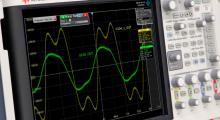
In this article we will see how it is more common the eventuality of having to monitor and measure fast signals of type differential (balanced signals), corresponding lines of clock High Speed or Serial Data Bus to high speed, during the repairs, debugging and/or testing of electronic equipment. Sometimes, however, the only instrument available is an oscilloscope with single ended channels and referred to GND (unbalanced), maybe with extended band (in our case we use an R&S RTO1044 (4GHz band, 4GSa/s).
In this article we will see how to implement the 1553 functional tests with the UUT acting as Remote Terminal.
We will implement four cases of functional tests, assuming that our unit under test acts as Remote Terminal and responds to the address 5 and subaddress 10 and 11 respectively to receive and transmit. The cases we will deal with are:
In this new series of articles, I will deal with the topic STD-MIL-1553 (cited for brevity as fifteen-fifty-three) illustrating the cases of typical tests. Before I get to the heart of the subject, I think it’s useful to bring back some protocol theory (I try to simplify as much as possible). In general, a BUS is an electrical medium and a set of rules by which multiple objects can communicate with each other by sharing the means of data transmission. The actors, interconnected between them, are of three types: